Disclosure: I build AnkiQuiz, the add-on discussed in the practice-question step below. This guide separates what Anki, question banks, and AnkiQuiz each do so you can decide whether that step belongs in your workflow.
The most useful medical-school Anki routine is not “do as many cards as possible.” It is a loop: learn a topic, unsuspend the matching cards, complete the reviews Anki schedules, then use questions to find out whether you can retrieve the same knowledge when the prompt changes.
Anki is the retention layer in that loop. AnKing organizes a large body of medical knowledge. A question bank tests application and exam-style reasoning. None of the three replaces the others.
The short version
- Learn one topic from class or a trusted medical resource.
- Unsuspend only the AnKing cards tagged to that topic.
- Finish due reviews before continually adding more new cards.
- Use practice questions to expose knowledge and reasoning gaps.
- Return to the relevant cards, or add a focused card when the gap is not covered.
Give each study tool one job
A common failure mode is asking Anki to do everything. Repeated cards can keep facts available, but they do not reproduce a timed question block, a long clinical stem, or the process of deciding which details matter.
A cleaner division of labor looks like this:
- Lectures and learning resources: build the first coherent mental model of a topic.
- Anki and AnKing: schedule retrieval so important facts remain available over time.
- UWorld, AMBOSS, and other question banks: test interpretation, integration, and exam-style application.
- Short quizzes made from your cards: check whether familiar card wording has become an unintended clue.
This distinction matters most when your reviews feel fluent but your question-bank performance does not. The answer is rarely “click through more cards.” First identify whether the miss came from a forgotten fact, a misunderstood mechanism, a misread stem, or faulty reasoning. Only a memory gap is automatically an Anki problem.
If reviews feel fluent while question-bank performance does not, use the 20-card recognition-versus-recall check to find the exact layer that is failing.
A sustainable M1/M2 daily workflow
1. Complete the reviews already due
Due reviews are the maintenance cost of material you previously chose to learn. Handle them in a protected block that fits your schedule. Morning works for many students, but consistency matters more than a particular hour.
If the queue is routinely too large, treat that as feedback. Pause new cards, reduce what you unsuspend, and decide which material is actually relevant. A new-card target copied from another student cannot account for your curriculum, card difficulty, rotations, or review speed.
2. Learn before you unsuspend
Keep a large premade deck suspended and release cards as you cover their material. The official AnKing course explains this tag-based workflow: choose the relevant resource or topic tag, select those cards, and toggle suspension. This prevents an enormous deck from becoming an enormous list of facts you have never understood.
If you are installing the deck, seeing zero cards, or learning how tags and daily reviews fit together, use the complete beginner AnKing workflow for medical school before activating a large batch.
Finished a Pathoma section, a Sketchy lesson, or a renal lecture? Find the matching tag and unsuspend that subset. If your school tests details that are absent from AnKing, add a small number of your own cards rather than duplicating every slide. The complete lecture-to-Anki workflow shows how to turn learning objectives into a sustainable card batch.
For subject-specific examples, use the microbiology workflow to separate organism models from mnemonic and wording cues, the mechanism-first Anki pharmacology workflow to connect drug targets, effects, uses, and important harms without activating an entire pharmacology deck, the pathology workflow to connect etiology, morphology, clinical findings, and complications, or the anatomy and Image Occlusion workflow to reduce mask-position cues and test structures from new views, or the mechanism-first biochemistry workflow to connect pathway regulation, enzyme deficiencies, and clinical consequences, or the physiology Anki workflow to preserve feedback loops and causal relationships without memorizing isolated arrows, or the cardiology Anki workflow to integrate hemodynamics, pathology, pharmacology, ECG rules, and clinical distinctions while keeping visual and audio practice in the study loop, or the renal physiology Anki workflow to connect nephron transport, clearance, acid-base relationships, and diuretic effects while keeping calculations and unfamiliar visuals in the study loop, or the pulmonology Anki workflow to connect ventilation, perfusion, mechanics, gas transport, and pulmonary disease while keeping unfamiliar data, imaging, and sounds in the study loop, or the gastroenterology Anki workflow to connect organ location, motility, secretion, digestion, absorption, liver function, and GI disease while keeping unfamiliar labs and images in the study loop, or the endocrinology Anki workflow to connect hormone axes, feedback, dynamic tests, glucose regulation, and endocrine drugs while keeping unfamiliar laboratory patterns and graphs in the study loop, or the hematology Anki workflow to connect blood-cell production, anemia, hemostasis, clonal disease, and pharmacology while keeping unfamiliar CBCs, smears, pathology, and coagulation data in the study loop, or the rheumatology Anki workflow to connect immune mechanisms, tissue patterns, systemic findings, and pharmacology while keeping examination, imaging, laboratory, and clinical reasoning practice in the study loop, or the neuroscience Anki workflow to connect structures, pathways, lesion localization, and unfamiliar visual views, or the immunology Anki workflow to connect immune signals, cells, effector functions, and clinical consequences, or the pediatrics Anki workflow to make age, developmental trajectory, current-source hygiene, and clinical task part of each retrievable relationship, or the surgery clerkship Anki workflow to preserve stability, timing, anatomy, care phase, and decision sequence.
3. Do the new cards while the topic is still coherent
Review the newly released cards after learning the source material. When a card seems confusing, return to the underlying concept instead of memorizing the card's sentence shape. Edit or suspend cards that are ambiguous, duplicated, or irrelevant to your goals. Use the focused AnKing suspend and unsuspend workflow before changing a large tag or resetting scheduling progress.
4. Finish with questions, not another passive pass
Questions reveal whether knowledge survives outside its original cue. Early in a course, that might be a small subject-specific set. As an exam approaches, question banks and official practice exams should take a larger share of the day.
How to connect UWorld mistakes back to Anki
Do not automatically create a card for every wrong answer. Diagnose the miss first:
- Knowledge gap: find and unsuspend the corresponding AnKing card, or create one concise card if the idea is not covered.
- Mechanism not understood: revisit the explanation or source material before writing a card.
- Stem-reading error: change how you annotate or pace questions; another fact card may not help.
- Reasoning error: explain why your chosen option was tempting and which finding should have changed the decision.
AnKing documents a UWorld QID workflow for finding cards associated with missed questions. Use it when available, but inspect the results before unsuspending everything. The goal is to patch a specific gap, not turn every explanation into a second question bank inside Anki.
For a question-by-question decision process, follow the UWorld incorrects Anki workflow . It separates knowledge gaps that may need a card from interpretation, reasoning, and timing errors that need another kind of practice.
For a stage-by-stage breakdown of how to divide study time, see Anki vs UWorld for preclinical courses, clerkships, and dedicated .
If you are already on rotations, use the clerkship and shelf-exam Anki workflow to triage Step 1-only cards, build a rotation-specific AnKing set, and protect clinical question practice.
Use FSRS without chasing a perfect settings recipe
Current Anki versions include FSRS. In the official Anki manual, desired retention controls how likely you are to remember a card when it becomes due. The default is 90%, and higher retention means shorter intervals and more daily reviews. The manual warns that workload rises quickly as the setting approaches 100%.
Start with the documented default unless your own data and constraints give you a reason to change it. Use FSRS optimization after you have meaningful review history. More importantly, grade honestly: if you did not retrieve the answer, press Again. A scheduling algorithm cannot compensate for generous self-grading.
Maximum reviews and new-card limits solve different problems. A new-card limit controls future workload. A review cap can hide cards that are already due. If you need to limit study time temporarily, understand that the remaining reviews have not disappeared; they are becoming a backlog.
For a current, setting-by-setting walkthrough, use the medical-school FSRS settings guide . If you create personal cards, the medical-school card-writing guide covers focused prompts, duplicates, cue leakage, and leech repair.
Add a reworded quiz without changing Anki scheduling
After enough repetitions, the exact phrasing, image position, or cloze shape can become part of the cue. A short quiz built from the same source cards offers a different retrieval check.
AnkiQuiz turns selected Anki cards into scored questions inside Anki. For a medical deck, select one focused subdeck or subject, include only fields with meaningful study content, and generate fewer questions than the number of available cards.
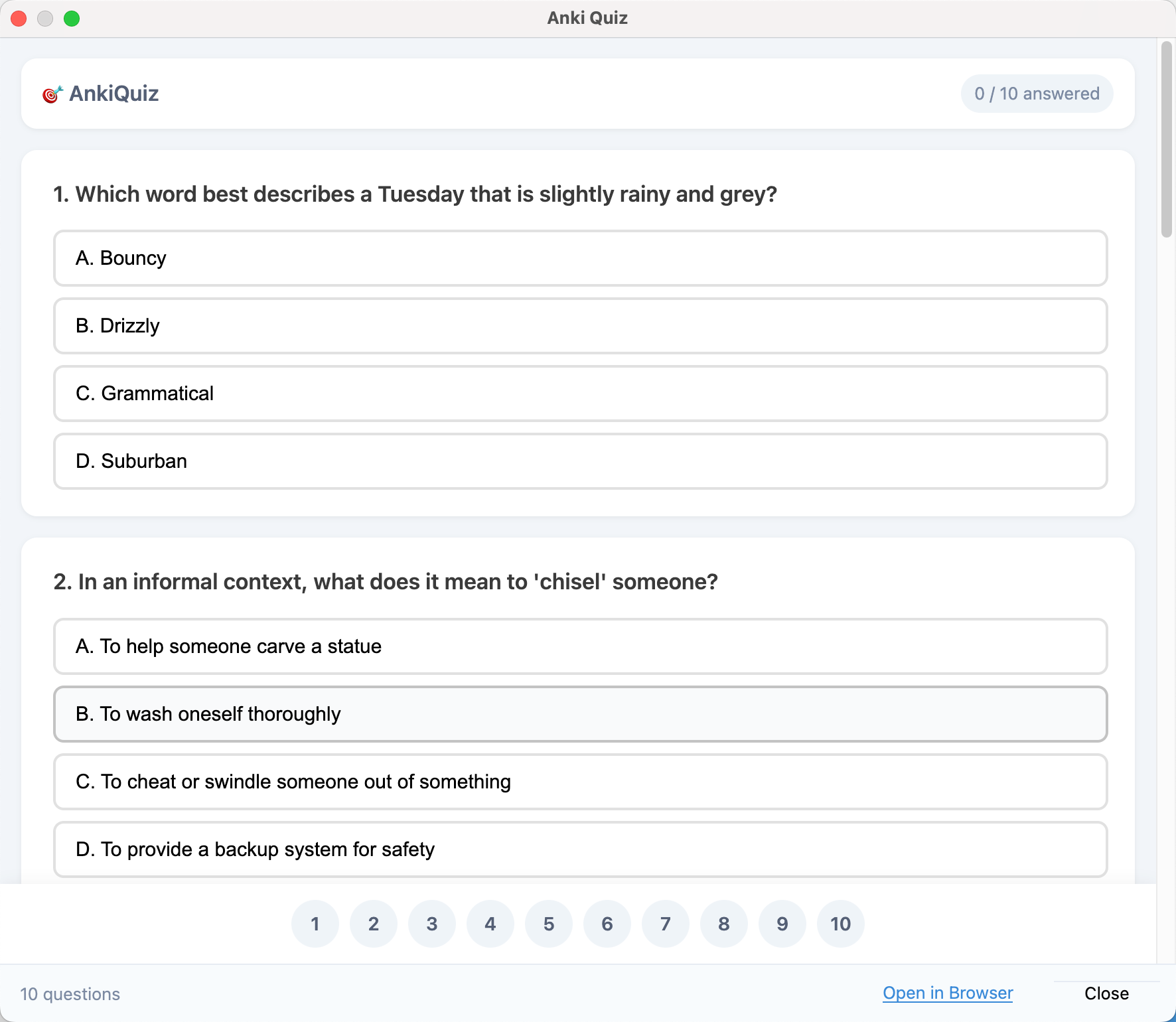
This is not a replacement for UWorld, an NBME self-assessment, or another validated exam-preparation resource. AnkiQuiz is instructed to stay grounded in the card content you provide. It cannot reliably create a full USMLE-style clinical vignette when the necessary clinical context is not in those cards.
Use it as a calibration step: if you recognize a card instantly but miss a reworded question about the same fact, revisit the card and explain the concept without looking. Quiz results do not reschedule the underlying Anki card.
What changes during dedicated study
Dedicated is not simply the preclinical routine at higher volume. Practice blocks, detailed review, and official self-assessments need enough time to influence your plan. Anki becomes maintenance and targeted repair rather than the center of the day.
- Keep mature, relevant cards in rotation if the workload remains useful.
- Unsuspend cards tied to genuine knowledge gaps found in question blocks.
- Stop adding broad new topics merely to “finish” a premade deck.
- Protect time for timed questions and careful explanation review.
- Reduce low-priority card work before sacrificing essential question practice.
For a complete exam-period schedule, card-triage method, and weak-topic repair loop, follow the Step 1 dedicated Anki workflow .
How to recover when reviews pile up
A backlog is a workload problem, not a moral failure. First set new cards to zero so the queue stops growing. Then separate current high-priority reviews from older or lower-priority material. Filtered decks and AnKing tags can help, but check the Anki manual on filtered decks before changing scheduling behavior.
Do not reset the entire deck just to make the number disappear. Preserve useful history, work in sustainable blocks, and suspend material you have consciously decided is no longer worth maintaining. If the queue repeatedly returns, the durable fix is usually fewer new cards or a narrower active deck.
If the queue will take more than a few sessions to clear, follow the medical-school Anki backlog recovery plan to separate newly due cards from older reviews without abandoning question-bank work.
Questions medical students commonly ask
How many new Anki cards should I do per day?
There is no universal number. Choose a volume whose future reviews you can sustain alongside classes and practice questions. If due reviews crowd out learning and question practice, your current intake is too high.
Should I finish every review before doing UWorld?
During routine coursework, keeping up with due reviews prevents silent backlog growth. During dedicated, do not let a very large card queue consume the time reserved for question blocks and review. Prioritize deliberately rather than following an absolute rule.
Can Anki replace practice questions?
No. Anki schedules retrieval of information represented by your cards. Question banks test how you interpret, combine, and apply information in unfamiliar situations.
Does AnkiQuiz work with AnKing?
Yes. It reads the active cards in the deck or subdeck you select. With a large deck, choose one focused subject and confirm the matching card count before generating a quiz. See the medical deck guide or the installation steps to try it.
A routine you can actually maintain
The best workflow is the one that keeps each tool in its proper role. Learn before memorizing. Unsuspend intentionally. Let Anki schedule retention. Let question banks expose application and reasoning gaps. Use a reworded card-based quiz when you need to check whether familiarity is inflating your confidence.
Start with one subject this week. Complete its due reviews, study the underlying material, do a small question set, and trace each miss to its real cause. That loop is more useful than chasing someone else's daily card count.