You recognize the pressure-volume loop or dose-response curve on your Anki card immediately. On a practice question, the labels change, two curves overlap, or the prompt asks what happens at a fixed input. Suddenly the familiar picture is hard to use.
Study physiology graphs with Anki by separating axis knowledge, relationships, and assumptions from visual recognition. Repair the specific step you miss, then interpret a different graph without the answer visible. AnkiQuiz can supplement this with reworded questions about verified text descriptions of those relationships.
Disclosure: We build AnkiQuiz and are not affiliated with Anki, AnKing, UWorld, NBME, or USMLE. This is a study workflow. Use assigned sources for physiological models and clinical interpretation; the numerical example below is an invented mathematical exercise.
For the daily routine around this work, start with the medical-school Anki workflow. This guide focuses on graph errors that survive successful card reviews.
Why remembering a curve is different from interpreting it
A repeated screenshot may let you answer from its color, caption, or position. An unfamiliar graph can ask a different retrieval task: define the axes, compare outputs at the same input, explain a shift, or decide what the evidence actually supports.
Treat these as separate checks. Can you describe the axes without the figure? Can you predict the relationship under stated conditions? Can you extract the requested comparison from a new figure? Passing one does not establish the others.
The official Anki manual recommends simple cards and understanding before memorization. For graphs, a focused prompt should retain the conditions needed for a clear answer. Splitting a graph into isolated arrows without those conditions can make the cards easy while losing the model.
Diagnose your first graph-reading error
After a miss, cover the explanation and reconstruct your reasoning. Write the requested quantity and the first step you could not justify.
- Axes: You reversed input and output, or read concentration as time. Repair the variable definitions and units.
- Scale: You treated equal spacing on a logarithmic axis as equal additive changes. Practice reading the actual tick labels before comparing points.
- Comparison: You compared different input values when the question required the same input. Draw the relevant vertical or horizontal comparison line on a practice copy.
- Model: You remembered a direction of change but forgot which variables were held constant. Restore the assumptions in the note.
- Task: You named a curve when asked for a value, slope, or change. Restate the requested operation before answering.
- Transfer: You recalled all the relevant facts but could not use a new display. Spend the next block on unfamiliar graphs and feedback rather than another definition card.
For calculations and unit errors, use the medical calculation Anki workflow. For a wider causal model, see Anki for physiology.
Keep a complete graph note, then make focused cards
Keep the permitted figure, source pointer, axis definitions, units, model assumptions, and explanation in the note. Add a source date when the content depends on a changing recommendation. Put supporting detail on the answer side instead of demanding an entire page on each review.
Useful prompts include:
- Axis card: “In this named model, what does the horizontal variable represent, and in what units?” Name enough context to avoid an ambiguous answer.
- Relationship card: “Under these stated conditions, how does output change when input increases?” Include the conditions in the question and the reason in the answer.
- Comparison card: “What must be held equal when comparing outputs between these two curves?” Answer from the actual model rather than memorizing a universal comparison rule.
- Assumption card: “Which condition makes this prediction valid?” Test a specific qualification that you repeatedly overlook.
Use a labeled image when the retrieval target is visual. Use an independent Basic prompt when the image itself gives away the answer. The medical Anki card-writing guide explains how to keep each task bounded.
Image Occlusion can hide an axis label or a feature, but a mask at a familiar location may supply its own hint. Pair that card with full-figure interpretation and a different authorized image. See Anki for anatomy and Image Occlusion for more on visual cue dependence.
Worked example: movement along a curve versus a changed relationship
Consider an invented linear model, not a physiological law: output Y = k × input X. Both axes use arbitrary units, the graph is linear, and the intercept is zero. In condition A, k = 2; in condition B, k = 3. Assume the model applies over the stated input range.
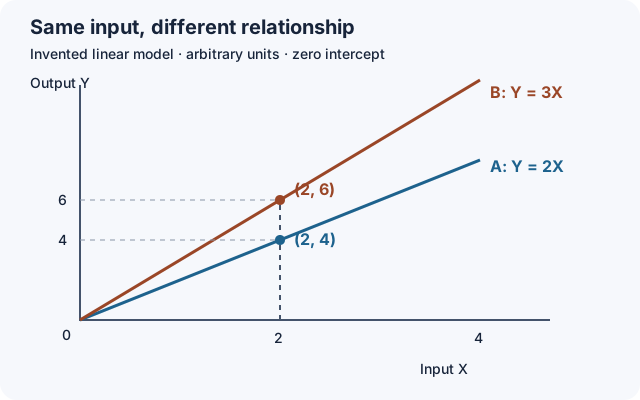
At X = 2, condition A gives Y = 4. At X = 4, the same condition gives Y = 8. That is movement along the same line because X changed while k stayed fixed.
At the same input X = 2, condition B gives Y = 6 instead of 4. Here the relationship changed: k increased, so the line is steeper. Calling this simply “moving right” fails to identify what changed.
A weak card says, “Higher k means higher Y.” Better prompts specify the comparison:
- “In Y = kX with positive fixed X and zero intercept, what happens to Y when k increases?” Answer: Y increases in proportion to k.
- “If X rises from 2 to 4 while k remains 2, did the relationship change?” Answer: no; the point moved along Y = 2X.
- “At fixed Y = 12, what input is required for k = 2 versus k = 3?” Answer: X = 6 versus X = 4. A higher output at fixed input and a lower required input at fixed output are compatible statements.
Draw both lines on paper, label the axes, and mark those comparisons. Later, use k = 4 and k = 6 at a fixed output of 24; the required inputs are 6 and 4. Explain why before checking the answer.
Medical curves can be nonlinear, have different intercepts, use logarithmic scales, or depend on additional variables. Rebuild the comparison from the assigned model. Do not transfer this toy model into a physiological or clinical prediction.
Use a short recall-to-graph practice block
Choose one recurring error rather than collecting every figure from a lecture. Check the source and repair an existing card if possible. Review the focused prompt, then draw or annotate the relationship without notes. Finally, interpret an unfamiliar permitted graph that tests the same distinction.
Change one feature deliberately: the numerical range, axis units, legend, or requested comparison. Preserve the model's assumptions. Explain what changed and what stayed fixed before reading the answer options. Reversing axes also changes what slope means; do not treat a visual rearrangement as automatically preserving every interpretation.
For examination practice, use representative course questions and authorized question-bank material. The official USMLE Step 1 preparation materials provide a starting point for official resources. Keep protected exam content out of tools you are not permitted to use with it.
Record whether the later miss involved axes, scale, comparison, assumptions, or the task. If you already recall the relationship but still misread unfamiliar displays, keep practicing that display-reading step. More card repetitions alone may leave it untouched.
Use AnkiQuiz for the text relationships behind a graph
AnkiQuiz for medical students generates supplemental questions from selected Anki text fields. It can help vary a question about axes, conditions, or a relationship that you have explicitly recorded. It does not interpret the graph image. An image filename or a caption saying “curve shifts” does not provide enough information for a grounded question.
- Check the source and write a complete text explanation: variables, units, relationship, controlled conditions, and the reason for the prediction. Include numerical values only when independently checked.
- In the desktop add-on, choose a suitable regular deck and select those text fields. Parent decks include subdecks. Tags and Browse selections do not define quiz input; filtered decks are excluded from the picker, and suspended or buried cards are excluded.
- Choose a time range that covers the intended material, generate a small quiz, and inspect which topics actually appeared. Verify every question, answer, option, and explanation against the source. Reject invented axes, unstated assumptions, or unsupported numerical results.
- Attempt the checked items later without notes. Then return to a different actual graph to test visual interpretation separately.
If your plan supports custom instructions, try:
Use only the supplied text. Test axis definitions, units, controlled variables, and the stated relationships. Distinguish a changed input from a changed model only when the text supports it. State what is held constant. Do not infer content from images or invent clinical values. Explain the deciding relationship; use direct recall when comparison context is incomplete.
Instructions do not guarantee accurate arithmetic, valid questions, or topic coverage. Selected text is sent for generation; use permitted material without identifiable patient information. AnkiQuiz does not validate physiology, alter Anki scheduling, or establish exam readiness.
Follow the installation guide and card-to-quiz walkthrough to try a small check from one verified note. Judge the repair by whether you can explain a fresh graph's axes, assumptions, and requested comparison.
Frequently asked questions
Why do I recognize physiology graphs in Anki but miss graph questions?
A familiar screenshot can supply visual cues without testing axis definitions, units, controlled variables, or the requested comparison. Locate the first failed step, repair that gap, and test it on an unfamiliar permitted graph.
Should I use Image Occlusion for physiology graphs?
Use it selectively for labels or features you need to recall. Also practice with the whole graph visible, explain its axes and assumptions, and interpret a different version. Removing a mask does not demonstrate graph interpretation.
Should I make an Anki card for every physiology graph?
No. Repair recurring, important gaps such as axis definitions, a conditional relationship, or a movement-versus-shift distinction. Keep complete graphs for reference and use unfamiliar graph problems for application.
Can AnkiQuiz read physiology graphs from my cards?
No. AnkiQuiz generates supplemental questions from selected text fields and does not interpret graph images. Supply verified axis definitions, units, relationships, and assumptions in text, check every generated item, and assess visual interpretation separately.
Explore the medical school Anki guides.